From Fear to Insight: Transforming Political Dialogue

As I listen to the collective voices of society, my concern is more for the health of our people than for those currently serving in the government. To be sure, politicians are always a concern, as they should be. But let’s put aside public names and personalities aside for a moment and take a look at ourselves.

Man in 19th-century attire dressed as Abraham Lincoln reading a letter in front of a large ornate mirror

Abraham Lincoln made a famous speech following the Civil War, known as the Gettysburg Address. He referred to our government as “of the people, by the people, for the people”. This is very important to remember. If our government is “by the people” then that means healthy people generate a healthy government.

Lincoln reminds us that we have a collective responsibility in keeping our democracy intact. Right now we have unhealthy people running the government between left and right factions. Neither side is healthy. We “the people” find ourselves jerked around in a political custody battle.

If our government is “by the people” then that means healthy people generate a healthy government. Lincoln reminds us that we have a collective responsibility in keeping our democracy intact.

When Nobody Wins

If one party wins and is able to destroy the other, nobody wins. If there is no healthy collaboration between parties then nobody wins. If it’s all resistance and no reasonableness, we have each party trying to over-correct the other. In many instances, it looks like we are swinging between extremes.

The fear narratives have both sides splitting off into extremes. We are too frequently getting lost in conspiracies and information wars that are unhelpful. Journalists and politicians alike often sound like lost children. Truth is reduced to my truth versus your truth. From there, we spiral into name calling and posturing until it’s our default reaction.
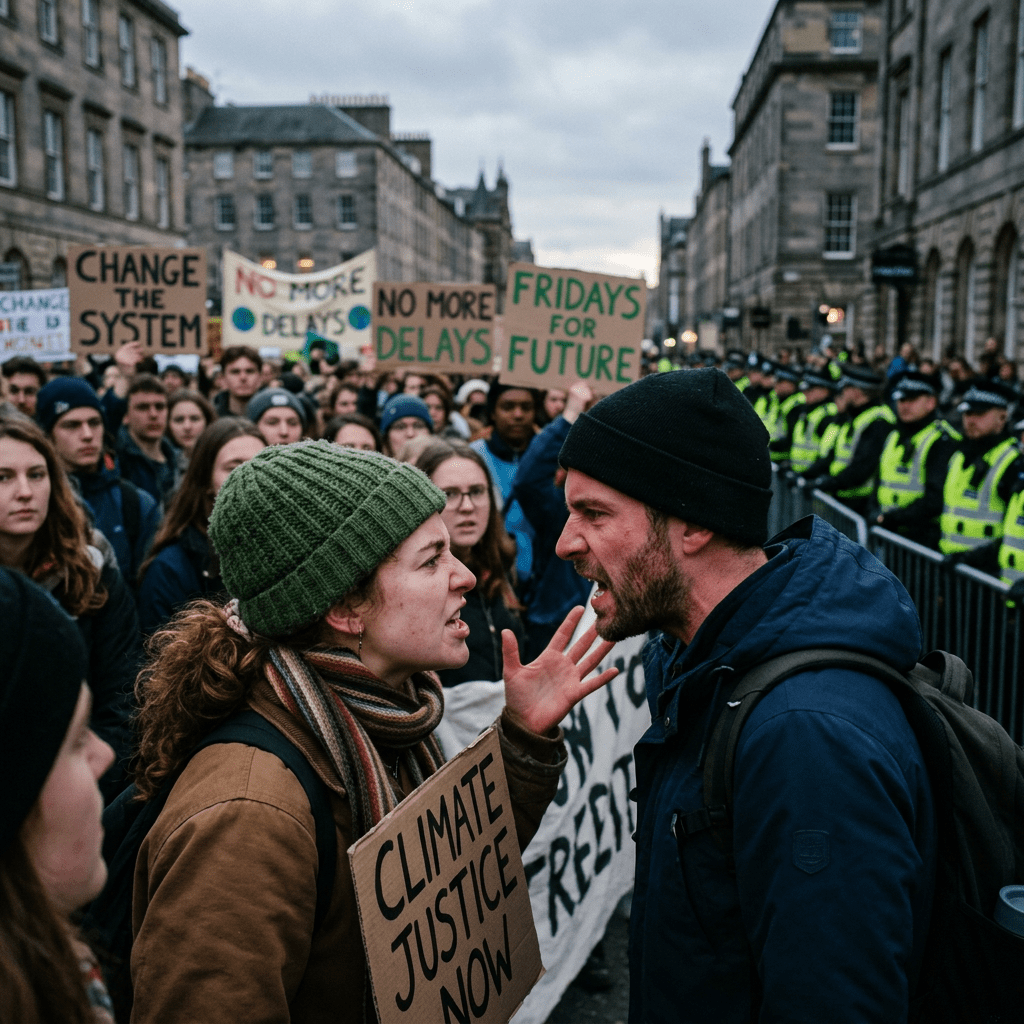
Two protesters argue intensely during a climate justice demonstration with signs and police officers in the background.

Unfortunately, people with a lot of fear and limited perspective tend to be the loudest. Their voices are given too much power these days. The latest crazy, unhinged person gets amplified by news media. Controversy is elevated to draw us into clicks and views, because fear is addictive and highly profitable.

Our brains respond powerfully to fear by looking for solutions and control. As a result, we sink slowly into the endless swirl of collective rumination and anxiety in a world where the internet never sleeps. To deal with this, we look to our ideological tribes for a sense of safety, security, and narrative. Thus, our anxious divisions increase.

Fear and anxiety have a tendency to disrupt our best thinking. When we make decisions and vote based on fear, we select news sources, politicians and policy that reflect that. Usually in that order.

Is This Helpful?

Every controversial moment has people on both sides on every level throwing the same ideological rocks at each other. Can we work on our collective self-awareness and ask, “Is this helpful”? Yet, all sides are angry and feeling absolutely morally justified in their positions and actions. Can we pause for a moment and see what we are doing to ourselves as a whole? Can we step away from our juicy conspiracy theories, algorithms and echo chambers? Can we lower the volume on our favorite journalists and influencers? Anxious momentum is hard to stop.

As a result, we sink slowly into the endless swirl of collective rumination and anxiety in a world where the internet never sleeps.

Spiral of glowing blue and orange data lines intertwined with galaxy stars and binary code

Our differences are real and necessary and good. We must allow for a certain amount of tension and discomfort that are naturally a part of our system of government. Our government was built for it. It is good to have multiple perspectives and opinions. We need the conflicts and disagreements to keep moving forward. From that point, people with real character, experience and courage can formulate the best solutions. These are the people we need to elect and support.

But first, we the people, must understand our role in the process. The politicians we select and the kind of pressure we put on them has a real impact on our present and future. Politicians tend to reflect the demeanor of the people they represent. As we continue to move away from healthy conflict into unhealthy contention, we must understand that we will continue to see this happen with our political leaders also. Rather than grow more frustrated with our leaders, let’s recognize where we as individuals have contributed.

Many of us have lost the ability to manage our own anxiety in healthy ways. Individuals tend to seek out other individuals with similar fears. This has the potential to be productive among well-informed, concerned citizens. However, when we see social behavior leading to predictable patterns of meaningless violence and chaos, both physically and verbally, it’s time to stop and evaluate ourselves.

Truth is not tethered to you, me, or a political party. It deserves to be seen objectively and from multiple angles so that reality can be discerned. Here are some helpful questions: Am I getting good information from multiple sources? What kind of biases am I drawing from? Is my activism helpful? Is my pacifism helpful? Do I have something to contribute that will help or am I holding back because I am too scared?

The politicians we select and the kind of pressure we put on them has a real impact on our present and future. Politicians tend to reflect the demeanor of the people they represent.

A calm, sound mind is a rare and valuable treasure these days. “We the people” need to find our way back to that kind of poise and demeanor in the face of our great challenges. We will be amazed to see the difference it makes on our representatives. As it stands, our constant entanglement with fear keeps our words and actions ineffective and our politicians on edge.

Why I’m Not Very Good at Christianity

When I was young I wanted to be good at Christianity. A good religious person works the system of Faith as prescribed. I understood that if you mark the right boxes on the to-do list and do them well then you’re a good Christian. I was overly self-confident and arrogant, relying on my own abilities and self-discipline to practice doing and being the person I thought would please God and bring success.

Thus far, I have tried to make God into a system or formula with some relationship in the mix. It wasn’t all false; I was really seeking him. And he continues to find me. Even while I’m lost and “doing it wrong”. In my own efforts, I figured if I practice the spiritual disciplines enough then I will get the results right. It’s sort of plug and play religious thinking. It’s an algebra problem. Solve for “X”. If you don’t get x right then figure out what you did wrong and try again.

Being a flawed human, there are endless possibilities of what I could have done wrong because I am imperfect. Plus the fact that my idea of what x should be is based on my own selfish, faulty assumptions and interpretations of the Bible and church life. X could mean success in the forms of prosperity, fame, comfort, book contracts, health, Christian converts, real estate, etc. If and when I achieve these things then I would assume I’m working the formula right and he is pleased with me.

But no, I’m too weak to run the entire gauntlet of steps needed to make the formula work. And so shame kicks in. There’s obviously something wrong with me. So maybe I should go into hiding until I get stronger and get the steps right. That’s what the greats do, right? They enter the desert, figure it out, God gives them strength and they emerge from their desert experience as Super Christian Heroes.

The truth is no one emerges from a real encounter with God wanting to be a Christian hero. Why? Because God is too much. Such an encounter usually involves a jarring life change. And so a real humility sets in. An overwhelming realization of my own limitations, inadequacies, and a painful awareness of my own deceitfulness and sin is burned into the soul, never to be forgotten. Since I cannot pretend anymore, the only option left is surrender. My own efforts and my own Christian algebra formula is an unsolvable equation.

“But he gives us more grace. That is why Scripture says:
‘God opposes the proud
    but shows favor to the humble.'”

James 4:6

I’m forced to have a relationship with God where I have no more games and nothing left to hide or prove. It’s a total sense of horror at my own deception and very freeing at the same time because he forgives me and loves me, knowing everything about me. It’s both terrible and wonderful at the same time. It’s a terrible blow to the pride and sense of self-sufficiency I used to have. However, I’m not alone in my struggles anymore.

I don’t really like it because I’m not in control. I don’t get to create my reality to suit my tastes and preferences. I do like it because he is here with all of his peace and presence to shepherd and take care of my needs one day at a time. Throughout the New Testament, Jesus calls someone and says, “Follow me”. His disciples dropped their fishing nets and other occupations and agendas and followed him. After that, they were no longer in control of their day to day lives.

Put simply, it’s transitioning from “I’m not very good at this” to “he is very good at this”. Thankfully, his grace is sufficient for me. It hurts my pride and comforts my soul. What a wonderful, uncomfortable thing to admit I’m not very good at Christianity.

“I have been crucified with Christ and I no longer live, but Christ lives in me. The life I now live in the body, I live by faith in the Son of God, who loved me and gave himself for me.”

Galations 2:20

Anger, Control, and Fear Erupting

Recently, I erupted with anger toward God. Beneath my anger I was feeling out of control. My eruption turned into a series of journal entries. Too honest. Too recent. Embarrassing. Can we just watch sports instead?

“Everyone of us is shadowed by an illusory person: a false self.. We are not very good at recognizing illusions, least of all the ones we cherish about ourselves.”

Thomas Merton, New Seeds of Contemplation

The Shadowy Figure Speaks

Somewhere behind my obsession with performing for God, a shadowy figure has emerged. This person is unknown to me until now. Wounded, bitter, and enraged. He is tired of the beating I give him. It appears I house a divided self: one who works desperately to please God and the other who has yet to know and rest in God’s true nature. The restless one erupts unexpectedly and painfully. Who is this strange person? He is me. He is hurting terribly. I should probably listen. I don’t really have a choice. The cat is out of the bag and the claws are extended. It’s time.

Father, there is a shadowy side of me that I have been hiding from myself and hiding from you. I am angry, bitter, and resentful. I am realizing how truly fearful I am of you and of the life you have given me. In Jesus, I am not supposed to be afraid. I should be at peace and at rest. But I am not. Beneath the anger is fear. And with the fear is my lost sense of control. If I could perform my way into your approval and the approval of people then perhaps I would finally feel secure. But you don’t work that way. You do not play by the rules of my games. And people are a moving target at best.

I am spiritually bankrupt, God. I have no other moves. I cannot figure this out or perform well enough. I am phony. All of my efforts to earn your approval are worthless. If I could earn your approval then perhaps there would be less uncertainty and smoother sailing. All along it has been about one more self-help book, one more discipline to add, one more year of growing, and a little more money to validate me.

“To live by grace means to acknowledge my whole life story, the light side and the dark. In admitting my shadow side I learn who I am and what God’s grace means.”

Brennan Manning, The Ragamuffin Gospel

Running Scared

I realize there are multiple levels of theology, psychology, and just common sense about life that my words and prayers seem to violate. A fear that has not been fully faced can create an irrational mess beneath the surface, as it has in me. I find myself strangely and anxiously driven, obsessive, and restless in the routines of everyday life. Until the fear is acknowledged and brought into the light, it remains hidden in the dark where my shadow self bears the brunt of it’s pain while my known self continues to perform under false pretenses.

If I could behave my way into the approval of God and people then all my security is based upon what I do in my own strength. Any slip, and it all falls apart. I am hard on myself because I need to give an optimal performance. Failure and shame are the worst case scenarios that I dread. And so I labor under this underlying dread. If this kind of fear driven behavior isn’t from God then where does it come from?

Great question. What are my fears trying to tell me? What does God have to say in response to my fears? I am studying a book called “Running Scared” by Edward T. Welch. His words are a companion as I walk through this time of dealing with my anger and fear as I look to God for his truth to bring renewal, rest and real surrender.

I wish I had a way to neatly tie up this entry. There is much more to explore. The light is slowly invading my resistance. I reach out and then I pull back again in terror. In starts and stops, like most real growth.

“Rather than minimize your fears, find more of them. Expose them to the light of day because the more you find, the more blessed you will be when you hear words of peace and comfort.”

Edward T Welch, Running Scared

This may seem like a disappointing development from an otherwise mature Christian. And it probably is. But for me this also reveals a beautiful, growing trust in my Father to bring these fears out of the darkness and show him. How often we are growing the most when it seems we are falling apart. The key is to keep moving towards him, bringing ourselves into the light. This is true maturity when he touches our places of immaturity.


“There is no fear in love. But perfect love drives out fear, because fear has to do with punishment. The one who fears is not made perfect in love.”

1 John 4:18